
Have you ever received a dumpster rental bill that was 30, 50, or even 100 percent higher than the original quote? You are not imagining things, and you are not alone. Hidden dumpster rental fees are one of the most common and most frustrating consumer complaints in the waste management industry. A quote that looks competitive at $299 can balloon to $550 or more by the time pickup day arrives, with charges for weight overages, extended rental periods, fuel surcharges, and prohibited item fees that were never clearly disclosed during booking.
This guide exposes the five most common hidden dumpster rental fees that companies bury in their terms and conditions, explains exactly how each fee works and when it triggers, and gives you the specific questions to ask before you book so you never face a surprise charge again. You will also learn how BBP Dumpster approaches pricing differently, with full transparency from the first call to the final invoice.
Continue reading to discover how to protect your budget, ask the right questions, and choose a dumpster rental provider that gives you the honest pricing you deserve.

What Are Hidden Dumpster Rental Fees?
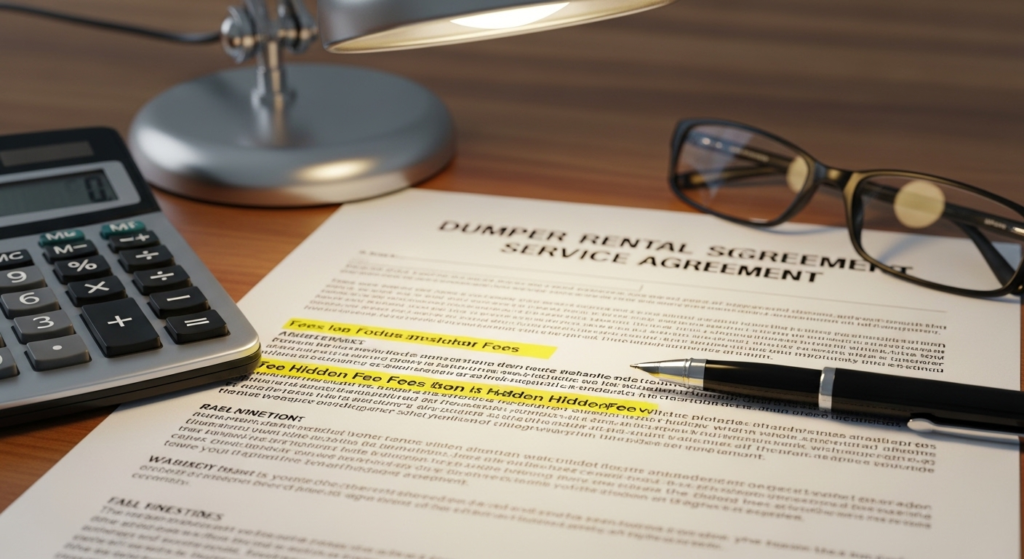
Hidden dumpster rental fees are charges that are not clearly disclosed in the initial quote or booking confirmation but appear on the final invoice after service is complete. These fees are technically legal because they are buried in the fine print of service agreements, but they are ethically problematic because they prevent customers from making informed decisions based on true total cost.
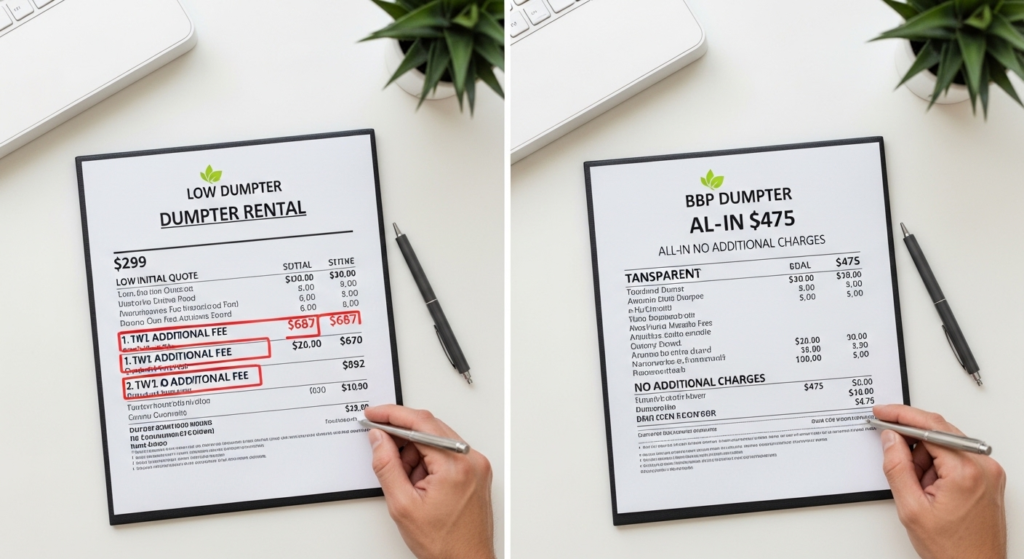
The practice of advertising low base rates while concealing additional charges is common in the dumpster rental industry. A company may quote $299 for a 10-yard container while knowing that the average customer in their market will generate enough debris to trigger $150 to $250 in additional charges. The low headline number wins the booking. The hidden dumpster rental fees generate the actual profit margin.
Understanding how these fees work, when they trigger, and how to identify them before booking is the most valuable knowledge any dumpster rental customer can have. It is also the reason BBP Dumpster built their entire pricing model around transparency. Their team discloses every potential charge during the initial consultation, so customers know their true total cost before the container is ever delivered.
Learn more about BBP Dumpster’s commitment to honest pricing on their about page and review their complete terms and conditions for full pricing details.
Why Hidden Dumpster Rental Fees Are So Widespread
The Low-Quote Competition Problem
The dumpster rental market is intensely price-competitive. When homeowners search for dumpster rental services, they typically compare three to five quotes and choose based primarily on the lowest advertised price. This creates a powerful incentive for companies to advertise artificially low base rates while recovering their actual margin through hidden dumpster rental fees applied after service.
The math works in the company’s favor. A customer who has already accepted delivery of a container and loaded it with debris has very little leverage to dispute charges on the final invoice. The debris is in the container. The container needs to be picked up. The customer pays.
This dynamic is why hidden dumpster rental fees persist despite being widely criticized. They work financially for the companies that use them, at least in the short term.
The Fine Print Problem
Most dumpster rental service agreements are written to protect the company, not the customer. Weight overage clauses, fuel surcharge provisions, and prohibited item fees are typically disclosed in dense legal language that most customers never read before booking. By the time the invoice arrives with unexpected charges, the customer has no practical recourse.
The solution is not to read every service agreement in detail before booking, though that is always advisable. The solution is to know which specific questions to ask before you commit, so you can identify hidden dumpster rental fees before they appear on your bill.
The 5 Hidden Dumpster Rental Fees Most Companies Won’t Tell You
Hidden Fee 1: Weight Overage Charges
Weight overage charges are the most common and most expensive hidden dumpster rental fees in the industry. Every container has a weight limit included in the base price. When your debris exceeds that limit, overage charges apply at a per-ton rate that is rarely disclosed prominently during booking.
How Weight Overage Fees Work:
The base rental price includes disposal up to a specified weight limit, typically 1 to 2 tons for a 10-yard container and 2 to 3 tons for a 15-yard container. Every ton of debris above that limit triggers an overage charge.
Typical Overage Rates:
- Industry standard: $55 to $80 per ton over the limit
- Some companies charge: $85 to $120 per ton
- Premium markets (Bay Area, NYC): Up to $150 per ton
Real-World Example: A homeowner books a 10-yard container with a 1-ton weight limit for a bathroom remodel. The project generates 2.5 tons of debris including cast iron fixtures, tile with mortar beds, and plaster walls. The overage charge at $75 per ton is $112.50 for the 1.5 tons over the limit. The $299 quote becomes a $411.50 invoice.
Why Companies Hide This Fee: Weight limits are often disclosed in small print or not mentioned at all during the booking call. Companies know that renovation debris is significantly heavier than customers expect, making overage charges a reliable revenue source.
How to Protect Yourself:
- Ask specifically: “What is the weight limit included in this price?”
- Ask: “What is your per-ton overage charge?”
- Estimate your debris weight using material weight guides
- Discuss heavy materials (concrete, tile, roofing) specifically during booking
- Consider sizing up if your project involves heavy materials
BBP Dumpster discloses weight limits and overage rates during every initial consultation. Their team proactively asks about heavy materials and recommends appropriate container sizes to prevent overage charges before they occur.
Hidden Fee 2: Extended Rental Day Charges
Extended rental day charges are hidden dumpster rental fees that apply when your project takes longer than the standard rental period included in the base price. Most companies include 7 days in their base rate. Projects that run longer trigger daily extension fees that are rarely disclosed clearly during booking.
How Extended Rental Fees Work:
The base rental price includes a standard rental period, typically 7 days. Every day beyond that period triggers a daily extension charge.
Typical Extension Rates:
- Industry standard: $15 to $25 per day
- Some companies charge: $30 to $50 per day
- Premium providers: Up to $75 per day
Real-World Example: A homeowner books a 7-day rental for a kitchen remodel that ends up taking 12 days due to contractor delays. At $25 per day, the 5 extra days cost $125. The $375 quote becomes a $500 invoice.
Why Companies Hide This Fee: Extension fees are often disclosed only in the service agreement, not during the booking call. Companies know that renovation projects frequently run longer than planned, making extension fees a predictable revenue source.
How to Protect Yourself:
- Ask specifically: “How many days are included in the base price?”
- Ask: “What is your daily extension charge?”
- Add 3 to 5 buffer days to your realistic project timeline
- Book a 14-day rental if your project timeline is uncertain
- Confirm the process for extending the rental if needed
BBP Dumpster includes rental period details in every written quote and confirms extension rates during the booking call. Their team recommends appropriate rental periods based on project scope rather than defaulting to the shortest period.
Hidden Fee 3: Fuel and Environmental Surcharges
Fuel and environmental surcharges are hidden dumpster rental fees that appear as separate line items on the final invoice, often described vaguely as “fuel surcharge,” “environmental fee,” “disposal fee,” or “administrative fee.” These charges are not included in the base quote and are rarely disclosed during booking.
How Surcharge Fees Work:
Fuel surcharges are typically calculated as a percentage of the base rental price or as a flat fee. Environmental fees are often described as covering the cost of responsible disposal, though this cost is typically already factored into the base disposal fee.
Typical Surcharge Amounts:
- Fuel surcharge: 5% to 15% of base price
- Environmental fee: $15 to $50 flat
- Administrative fee: $10 to $35 flat
- Combined surcharges: $25 to $100 on a typical rental
Real-World Example: A homeowner receives a quote of $350 for a 15-yard container. The final invoice includes a $35 fuel surcharge (10% of base), a $25 environmental fee, and a $15 administrative fee. The $350 quote becomes a $425 invoice with $75 in surcharges never mentioned during booking.
Why Companies Hide This Fee: Surcharges allow companies to advertise lower base rates while recovering additional revenue through fees that sound legitimate and necessary. Customers rarely question charges described as “environmental” or “fuel” because they seem like unavoidable external costs.
How to Protect Yourself:
- Ask specifically: “Are there any surcharges, fees, or additional charges not included in this quote?”
- Ask: “Is this quote the total all-in price, or are there additional fees?”
- Request a written itemized quote before confirming your booking
- Review the service agreement for any fee language before signing
BBP Dumpster provides all-in pricing that includes all fees and surcharges in the initial quote. There are no surprise line items on the final invoice. What you are quoted is what you pay, subject only to weight overages if debris exceeds the included limit.
Hidden Fee 4: Prohibited Item and Contamination Fees
Prohibited item and contamination fees are hidden dumpster rental fees that apply when customers place restricted materials in the container. These fees are among the most expensive in the industry and are frequently triggered by customers who were never clearly informed about what items are prohibited.
How Contamination Fees Work:
When a driver discovers prohibited materials in a container during pickup, the load is flagged as contaminated. The customer is charged a contamination fee that can range from $100 to $1,000 or more depending on the material type and the remediation required.
Common Prohibited Items That Trigger Fees:
- Paint, stains, and solvents: $150 to $400 fee
- Batteries (all types): $100 to $250 fee
- Electronics and e-waste: $100 to $300 fee
- Appliances with refrigerants: $200 to $500 fee
- Tires: $50 to $150 per tire
- Asbestos-containing materials: $500 to $2,000 fee
- Motor oil and automotive fluids: $150 to $400 fee
- Propane tanks: $100 to $300 fee
Real-World Example: A homeowner doing a garage cleanout places several old paint cans, a car battery, and a bag of motor oil containers in the dumpster without realizing these items are prohibited. The contamination fee is $350 for the paint and solvents, $150 for the battery, and $200 for the automotive fluids. The $350 rental becomes a $1,050 invoice.
Why Companies Hide This Fee: Prohibited item lists are typically disclosed only in the service agreement, not during the booking call. Some companies provide a list only when asked directly. The result is that customers frequently place prohibited items in containers without knowing the financial consequences.
How to Protect Yourself:
- Ask specifically: “What items are prohibited in your containers?”
- Request a written prohibited items list before your project begins
- Research local hazardous waste disposal options for restricted materials
- Separate potentially prohibited items before loading begins
- When in doubt, ask before loading
BBP Dumpster provides a complete prohibited items list during every booking call and follows up with written documentation. Their team proactively discusses common prohibited items based on the customer’s project type, preventing contamination fees before they occur.
Hidden Fee 5: Difficult Access and Delivery Surcharges
Difficult access and delivery surcharges are hidden dumpster rental fees that apply when the delivery location presents challenges for the driver or truck. These fees are almost never mentioned during booking and appear on the invoice as vague line items like “special delivery fee” or “access surcharge.”
How Access Surcharges Work:
Delivery trucks require specific clearance dimensions and access conditions. When a property does not meet standard requirements, additional time and effort are required for delivery. Companies charge for this additional effort through access surcharges that are rarely disclosed upfront.
Common Access Surcharge Triggers:
- Steep driveway grade: $50 to $150 surcharge
- Very narrow access path (under 10 feet): $50 to $100 surcharge
- Hillside property requiring special positioning: $75 to $200 surcharge
- Long driveway requiring extended reach: $50 to $100 surcharge
- Tight urban placement requiring multiple attempts: $50 to $150 surcharge
- Gravel or unpaved surface: $25 to $75 surcharge
Real-World Example: A Concord homeowner with a steep hillside driveway books a dumpster rental without mentioning the grade. The driver arrives and requires additional time and equipment to safely position the container. A $125 difficult access surcharge appears on the final invoice. The $400 quote becomes a $525 invoice.
Why Companies Hide This Fee: Access surcharges are difficult to predict without a site visit, which most companies do not conduct. Rather than asking detailed questions during booking, some companies simply apply the surcharge after delivery when the customer has no practical recourse.
How to Protect Yourself:
- Describe your property access in detail during booking: driveway grade, width, length, overhead clearance, surface type
- Ask specifically: “Are there any surcharges for difficult access or delivery conditions?”
- Ask: “What access conditions might trigger additional charges?”
- Request that any access surcharges be disclosed before delivery, not after
- Consider requesting a site assessment for properties with unusual access conditions
BBP Dumpster asks detailed access questions during every booking call. Their experienced drivers are familiar with Bay Area property types, including the hillside properties common in Concord and surrounding communities. Access challenges are identified and priced before delivery, not after.
The Complete Hidden Fee Comparison Table
| Fee Type | Industry Range | Trigger | Prevention |
|---|---|---|---|
| Weight overage | $55-$150 per ton | Debris exceeds weight limit | Accurate weight estimation, size up |
| Extended rental | $15-$75 per day | Project exceeds rental period | Book longer period, add buffer days |
| Fuel/environmental surcharge | $25-$100 flat | Applied automatically | Request all-in quote upfront |
| Contamination/prohibited items | $100-$2,000 | Restricted materials in container | Get prohibited list before loading |
| Difficult access | $50-$200 | Challenging delivery conditions | Describe property access in detail |
| Total potential hidden fees | $245-$2,525 | Multiple triggers | Ask the right questions |

How to Avoid Hidden Dumpster Rental Fees: The Complete Question Checklist
Before confirming any dumpster rental booking, ask these specific questions to identify hidden dumpster rental fees before they appear on your invoice.
Questions to Ask Every Provider
Pricing and Fees
- Is this quote the total all-in price, or are there additional fees not included?
- Are there any surcharges, fuel fees, environmental fees, or administrative fees?
- What is the weight limit included in this price?
- What is your per-ton overage charge if I exceed the weight limit?
- How many rental days are included in the base price?
- What is your daily extension charge if I need more time?
Prohibited Items
- Can you provide a complete list of prohibited items?
- What is the contamination fee if prohibited items are found in the container?
- What happens if I accidentally place a prohibited item in the container?
Delivery and Access
- Are there any surcharges for difficult access or delivery conditions?
- What access conditions might trigger additional charges?
- Do you charge for driveway protection boards?
Pickup and Completion
- Are there any fees for early pickup or rescheduling?
- What happens if the container is overfilled above the rim?
- Are there any fees for containers left on the street?
Documentation
- Can you provide a written itemized quote before I confirm?
- Where can I review your complete terms and conditions?
BBP Dumpster answers every one of these questions transparently during the initial consultation. Their team welcomes detailed questions because they have nothing to hide. Review their complete terms and conditions before booking to see exactly how their pricing works.
How BBP Dumpster Does Pricing Differently
BBP Dumpster was built on a simple principle: customers deserve to know exactly what they will pay before the container arrives. This commitment to transparent pricing is not just a marketing claim. It is reflected in every aspect of how they operate.
What Transparent Pricing Looks Like at BBP Dumpster:
- Every quote includes all fees and surcharges in the initial price
- Weight limits and overage rates are disclosed during the first call
- Rental period and extension rates are confirmed in writing
- Prohibited items list is provided before booking is confirmed
- Access questions are asked proactively to identify any surcharges before delivery
- Final invoice matches the written quote unless weight overages apply
“I had been burned by hidden fees from another company on a previous project. When I called BBP Dumpster, they went through every potential charge with me before I even gave them my credit card. The final bill was exactly what they quoted. That kind of honesty is rare in this industry.” – Homeowner, Concord, CA
“BBP Dumpster’s pricing was completely transparent from start to finish. No surprises, no hidden fees, no excuses. They even called me mid-project to let me know I was approaching the weight limit so I could make an informed decision about whether to continue loading or schedule an early pickup. That proactive communication saved me from an overage charge.” – Contractor, Bay Area, CA
Check BBP Dumpster’s verified customer reviews on Google and Yelp to see what Bay Area homeowners and contractors say about their pricing transparency and service quality.
Real Customer Stories: The True Cost of Hidden Fees
Case Study 1: The Renovation That Cost Twice the Quote
The Situation: A Concord homeowner booked a 15-yard dumpster from a national provider for a kitchen and bathroom renovation. The quoted price was $325. The final invoice was $687.
The Hidden Fees:
- Weight overage: $180 (2.4 tons over the 2-ton limit at $75/ton)
- Fuel surcharge: $42 (13% of base price)
- Environmental fee: $25 (flat fee not disclosed during booking)
- Extended rental: $115 (4.6 days at $25/day due to contractor delays)
The Lesson: The homeowner had no idea the project would generate 4.4 tons of debris. The tile with mortar beds, cast iron tub, and plaster walls were far heavier than expected. A proper sizing consultation would have identified the weight risk and recommended a container with a higher weight allowance.
What BBP Dumpster Would Have Done: During the booking call, BBP Dumpster would have asked about the specific materials being removed, identified the weight risk from cast iron and tile with mortar, recommended a 20-yard container with a 3-ton weight allowance, and quoted the all-in price including all fees. The total cost would have been approximately $475, saving the homeowner $212 compared to the final invoice from the national provider.
Case Study 2: The Garage Cleanout Contamination Surprise
The Situation: A Pleasant Hill homeowner booked a 10-yard dumpster for a garage cleanout. The quoted price was $299. The final invoice was $849.
The Hidden Fees:
- Contamination fee for paint cans: $250
- Contamination fee for old car battery: $150
- Contamination fee for motor oil containers: $150
The Lesson: The homeowner had no idea that paint, batteries, and motor oil were prohibited items. The booking call never mentioned prohibited materials. The prohibited items list was buried in the service agreement that the homeowner never read.
What BBP Dumpster Would Have Done: During the booking call, BBP Dumpster would have asked what types of items the garage contained, identified the paint, battery, and automotive fluid risk, provided the complete prohibited items list, and recommended local hazardous waste disposal options for the restricted materials. The contamination fees would never have occurred.
Contact BBP Dumpster at (925) 940-9906 or through their contact page to experience the difference that transparent pricing makes from the very first call.

What to Do If You Have Already Been Charged Hidden Fees
If you have already received a dumpster rental invoice with unexpected charges, you have options.
Step 1: Review Your Service Agreement
Locate the service agreement you signed or accepted during booking. Review the fee language carefully to determine whether the charges are technically disclosed, even if they were not clearly communicated during the booking call.
Step 2: Document the Discrepancy
Compare the written quote you received during booking with the final invoice. Document every charge that was not included in the original quote. Note whether each charge was disclosed in the service agreement or not disclosed at all.
Step 3: Contact the Company Directly
Contact the company’s customer service department with your documentation. Explain that specific charges were not disclosed during booking and request a review. Many companies will reduce or waive undisclosed fees when customers raise the issue professionally and with documentation.
Step 4: Dispute Through Your Credit Card
If the company refuses to address undisclosed charges, contact your credit card company to dispute the charges. Provide your original quote, the final invoice, and documentation showing that the disputed charges were not disclosed during booking. Credit card companies frequently side with consumers in billing dispute cases involving undisclosed fees.
Step 5: Leave an Honest Review
Share your experience through Google, Yelp, and other review platforms. Honest reviews about hidden dumpster rental fees protect other consumers from the same experience and create accountability for companies that use deceptive pricing practices.
Frequently Asked Questions
What are the most common hidden dumpster rental fees?
The five most common hidden dumpster rental fees are weight overage charges ($55 to $150 per ton), extended rental day fees ($15 to $75 per day), fuel and environmental surcharges ($25 to $100 flat), prohibited item contamination fees ($100 to $2,000), and difficult access delivery surcharges ($50 to $200). Together, these fees can add $245 to $2,525 to a quoted price. Always ask for an all-in written quote before confirming any booking.
How do I avoid hidden dumpster rental fees?
To avoid hidden dumpster rental fees, ask for a written all-in quote that includes all fees and surcharges before confirming your booking. Ask specifically about weight limits, overage rates, rental period length, extension charges, prohibited items, and access surcharges. Request a complete prohibited items list before loading begins. Choose providers like BBP Dumpster that build transparent pricing into their standard process.
What is a weight overage fee for dumpster rental?
A weight overage fee is a charge applied when your debris exceeds the weight limit included in the base rental price. Overage rates typically range from $55 to $150 per ton above the limit. A 10-yard container typically includes 1 to 2 tons. A 15-yard container typically includes 2 to 3 tons. Renovation debris including concrete, tile, and roofing materials is significantly heavier than household items and commonly triggers overage fees.
Are dumpster rental fuel surcharges legitimate?
Fuel surcharges are technically legitimate costs but are considered hidden dumpster rental fees when they are not disclosed during the booking process. A transparent provider will include fuel costs in the base price or disclose the surcharge amount during the initial quote. If a fuel surcharge appears on your final invoice without prior disclosure, you have grounds to dispute the charge.
How do I know if a dumpster rental company has hidden fees?
Signs that a dumpster rental company may have hidden dumpster rental fees include unusually low advertised prices compared to competitors, vague or incomplete answers to direct questions about fees, refusal to provide a written itemized quote, service agreements with extensive fine print fee language, and online reviews mentioning billing surprises. Choose providers that welcome detailed fee questions and provide written all-in quotes before booking.
Conclusion
Hidden dumpster rental fees are a widespread industry problem that costs consumers hundreds to thousands of dollars on projects where they were already operating on a tight budget. The five fees exposed in this guide, weight overages, extended rental charges, fuel and environmental surcharges, contamination fees, and difficult access surcharges, are responsible for the majority of billing surprises in the dumpster rental industry.
The key takeaways from this complete guide to hidden dumpster rental fees include:
- Weight overage fees are the most expensive and most common hidden charge
- Extended rental fees trigger frequently because renovation projects run longer than planned
- Fuel and environmental surcharges are often applied automatically without disclosure
- Contamination fees are preventable with a complete prohibited items list before loading
- Access surcharges can be avoided by describing your property in detail during booking
- Always request a written all-in quote before confirming any booking
- Ask the complete question checklist provided in this guide before every booking
- Choose providers that welcome transparency questions and provide written documentation
The difference between a $299 quote that becomes a $687 invoice and a $475 all-in quote that stays at $475 is not luck. It is choosing the right provider and asking the right questions before you commit.
BBP Dumpster has built their entire business on the principle that customers deserve honest pricing from the first call to the final invoice. Their team discloses every potential charge during the initial consultation, provides written all-in quotes, and proactively communicates during your rental period to help you avoid unexpected charges.
Ready to experience dumpster rental with no hidden fees in Concord or anywhere in the Bay Area? Contact BBP Dumpster today at (925) 940-9906 or visit their contact page for a completely transparent quote. Their experienced team will walk you through every potential charge, recommend the right container size for your project, and give you the honest pricing you deserve.
Do not let hidden dumpster rental fees derail your project budget. Book with BBP Dumpster and experience the difference that genuine transparency makes. Learn more about their pricing philosophy and service commitment on their about page. Check their service areas page to confirm coverage for your location and review their privacy policy for complete service documentation.
Company Information
BBP Dumpster
Address: 4918 Clayton Rd, Concord, CA 94521, United States
Phone: (925) 940-9906
Email: bbpdumpster@gmail.
Office Hours: 9 AM to 5 PM Monday through Friday, 9 AM to 2 PM Saturday